
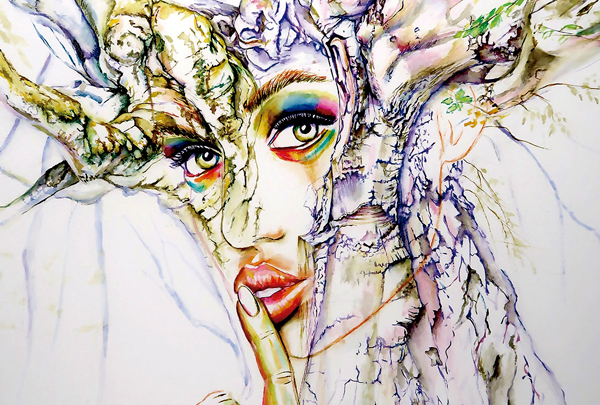
What makes us feel
Sometimes we stand before a work of art that moves us before we know why. Something resonates and is clearly perceived, even if we cannot yet explain it. There is an understanding, a silent recognition that happens before we think.
Perhaps this is where the true relationship between art and the viewer begins: a dialogue that does not involve words, but experience.
Inner resonance
This silent language works through resonance, association, and direct perception. It is made up of rhythms, repetitions, and subtle relationships between shapes and colors.
When an image acts in this way, looking ceases to be passive: attention becomes more present, the gaze pauses, and something within us responds. It is more than seeing; it is feeling how the image affects us, silently, inside.
It is not a matter of turning off the mind, but of allowing it to accompany the experience without directing it, leaving room for an understanding that does not come solely through words.
The time of art
In the fast-paced rhythm in which we live, the silence of art invites us to pause, to look without haste, to perceive without the need to understand everything immediately.
The work does not demand a quick response or a single interpretation. It offers itself as an experience that each person receives in their own way. Its strength lies in this openness, in the stillness it proposes: a space where the gaze becomes a sustained presence.
Art as a nonverbal language
Art speaks in its own language of symbols, colors, and shapes. It presents itself to us as a presence that activates a perception that escapes reasoning and draws us into its own world. To contemplate a work of art is not so much to understand what it “means” as to allow something to manifest itself without the need to name it.
A shared territory
Art moves in an intermediate space between the spiritual and the rational. The aesthetic experience reaches deep layers of perception and can be understood beyond explanations.
Each person approaches a work of art from their own history, sensitivity, and moment in life. That is why the language of art opens up a space for encounter.
What is awakened in the viewer is not literally contained in the work, but neither does it arise solely from the person. It appears in the relationship between the two.
Silence is not emptiness: it is the place where that relationship can occur.
From that shared space, the gaze becomes more attentive and present.