
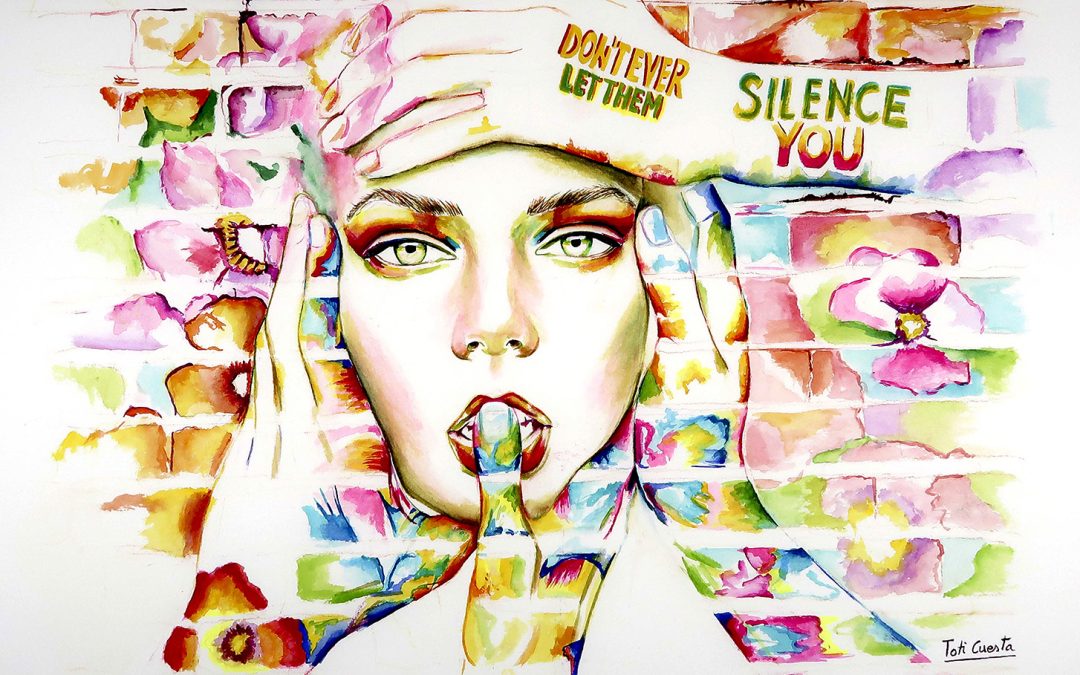
There are images we understand immediately, and others that, when we look at them, we feel a dimension escapes us in what they convey. In the latter, there is usually a symbol: a form that, in addition to being shown, suggests. We see “trees,” “mountains,” or “faces,” and we perceive that there is something there, difficult to name, that is clearly present.
A symbol is an image that operates on two levels at once. On the one hand, the recognizable: that which we can point to and describe. On the other hand, a broader dimension, which is intuited rather than understood. This double layer makes the symbolic image a language charged with depth beyond words.
What is activated when we look
When someone stops in front of one of my paintings, in addition to identifying human figures, roots, or mountains, they often experience some emotion. Sometimes they tell me they feel calm, vertigo, expansion, or a sensation that is difficult to explain. This is where the symbolic dimension of the image begins: what is set in motion beyond the visible form.
Painting acts as a bridge. While the mind recognizes familiar forms, a silent space opens up where associations, memories, emotions, and intuitions appear. This response varies from person to person and is renewed each time. Each gaze opens up a different journey within the same work.
Collective language
Many of the forms that appear in art, such as trees, mountains, water, or light, have accompanied humanity since its origins. That is why they are repeated in mythologies, dreams, stories, and paintings. They refer to fundamental experiences: being born, growing up, getting lost, transforming, and awakening.
At this level, the symbol is part of a shared memory. Thanks to this common ground, certain images are familiar even when we do not know their history or cultural explanation. The same watercolor can be recognized as a “tree,” “landscape,” or “emerging figure” by very different people, although each expresses it in their own words.
What awakens in each person
Beyond what is shared, each image encounters the life of the person who contemplates it. The same work can awaken serenity in one person and unease in another. Some people focus on the faces that appear among the branches; others linger on the landscape; still others are absorbed by the color.
This response is deeply personal. The image acts as a mirror, reflecting internal aspects that are increasingly present in consciousness. The symbolic emerges from the encounter between the painting and the observer. For this reason, the relationship with the same work can change over time: the view at age twenty is not the same as after a loss, a crisis, or a major life transformation.
A language with common roots
The power of a symbolic image lies in its ability to hold both the common and the intimate simultaneously. It shares forms that many people can recognize, but allows each viewer to find their own resonance. Instead of closing itself off to a single interpretation or a personal reading, itopens up a space where both dimensions coexist and enrich each other.
To listen to a symbol is to give it time. It is to remain before the image without haste, allowing what it arouses internally to have space to appear. Rather than deciphering it, it is about accompanying what it awakens. At that moment, the image ceases to be external and becomes a living experience, shared between the viewer’s inner world and a broader reality that includes us all.